
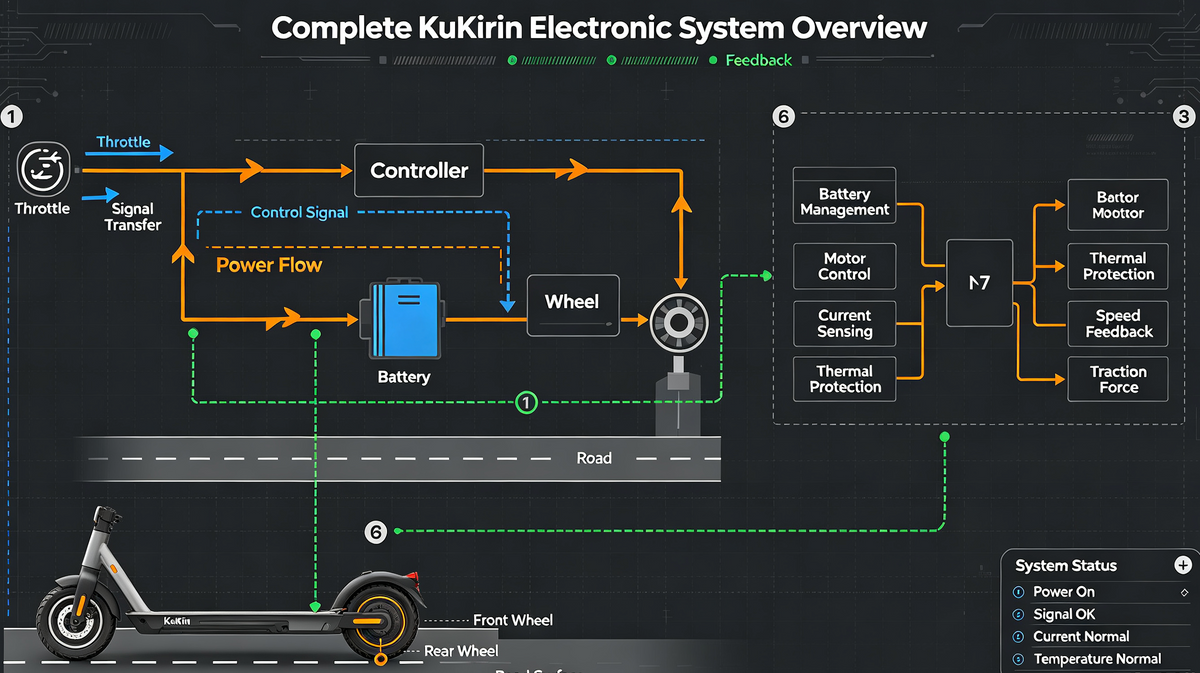
When you twist the throttle on an electric scooter, the scooter begins accelerating almost immediately.
From the rider's perspective, the process seems simple.
Twist the throttle.
The motor turns.
The scooter moves.
But inside the scooter, several electronic systems are communicating and working together within a very short period of time.
The throttle generates an input signal. The controller interprets that signal. The battery provides electrical energy. The motor converts electrical energy into rotational force. The wheel transfers that force to the tire, and the tire interacts with the road.
This is the complete electronic story behind electric scooter movement.
Step 1: The Rider Creates an Input
Everything begins with the rider.
When you twist the throttle, you are not directly powering the motor.
Instead, you are creating an electronic command.
The throttle contains a sensor that detects its position and communicates that information to the scooter's control system.
The more the throttle is activated, the more acceleration the rider is requesting.
This is similar to pressing an accelerator pedal in a car, but the electronic architecture of an electric scooter is much more compact.
The important idea is simple:
The throttle requests power; it does not create power.
That distinction helps explain why the battery and controller are so important.
Step 2: The Controller Interprets the Signal
The throttle signal then reaches the controller.
The controller acts as the central electronic management component of the drive system.
It receives information from multiple parts of the scooter and determines how the motor should respond.
A simplified process looks like this:
Throttle input → Controller → Motor command
The controller does not simply send maximum electrical power whenever the throttle moves.
Instead, it regulates electrical output according to the system's operating conditions.
This is one reason the controller has such an important effect on the character of an electric scooter.
Acceleration smoothness, power delivery, and motor response are all connected to the electronic control system.

Step 3: The Battery Provides Energy
While the throttle provides the command, the battery provides the energy.
This distinction is fundamental.
The battery stores electrical energy inside the scooter. When acceleration is requested, the controller draws on that available energy and regulates its delivery toward the motor.
Battery voltage and capacity describe different characteristics.
Voltage relates to the electrical potential of the battery system.
Capacity describes how much electrical charge the battery can store.
Together, these characteristics help define the electrical environment in which the motor and controller operate.
This is why a scooter's battery specification should always be considered together with its motor and controller rather than viewed as an isolated number.
Step 4: The Controller Sends Power to the Motor
Once the controller has interpreted the rider's request, electrical power is delivered to the motor.
Most modern performance-oriented electric scooters use brushless motor technology.
Inside the motor, electrical energy creates magnetic interactions between stationary and rotating components.
These interactions generate rotational force.
The motor does not directly push the scooter forward.
Instead, it creates rotation.
That rotation is transferred to the wheel.

Step 5: The Motor Turns the Wheel
The motor's rotational force reaches the wheel.
On a hub-motor scooter, the motor is integrated into the wheel assembly, making the mechanical path relatively direct.
The motor rotates the wheel.
The wheel rotates the tire.
The tire interacts with the road.
This creates the final transition from electrical energy to physical movement.
The complete process can therefore be summarized as:
Electrical energy → Magnetic interaction → Motor rotation → Wheel rotation → Tire movement
This is one of the most fascinating aspects of electric scooter technology.
A battery stores chemical energy.
That energy becomes electrical energy.
The motor transforms electrical energy into mechanical rotation.
The tire finally converts that rotation into forward movement.

Step 6: The Tire Creates Forward Motion
The tire is the final physical connection between the scooter and the road.
A rotating tire alone does not guarantee forward movement.
The tire must interact with the road surface and generate sufficient traction.
This is why tire design matters.
Tire size, tread pattern, rubber compound, inflation, road conditions, rider weight, and riding environment can all affect how effectively motor power reaches the ground.
In simple terms, the motor creates rotational force, but the tire determines how that force interacts with the road.
This is also why maximum motor power should not be considered separately from the rest of the scooter.
Power must eventually be transferred through the wheel and tire.
Step 7: The Brake System Changes the Equation
The electronic system is not only responsible for acceleration.
It also participates in braking.
When the rider activates a brake control, the scooter's electronic system can receive a brake signal.
Depending on the scooter's architecture, electronic braking can work together with mechanical braking components.
Mechanical disc brakes provide physical friction at the wheel.
Electronic braking can modify motor behavior.
Together, these systems create a coordinated approach to slowing the scooter.
This demonstrates another important principle:
The controller does not only manage acceleration. It also participates in the scooter's broader control system.
Step 8: The Display Communicates With the Rider
The rider also needs information about what the scooter is doing.
That is where the display and related electronic interfaces become important.
Depending on the model, the rider may be able to see information such as speed, battery status, riding mode, or other system data.
The display does not usually create propulsion.
Instead, it acts as an information interface between the rider and the electronic system.
This creates another communication loop:
Scooter system → Display → Rider
The rider sees information, adjusts input, and the system responds.

How KuKirin Models Apply This Architecture
Different KuKirin scooters use different combinations of motors, batteries, controllers, and electronic systems.
For example, the KuKirin G2 is listed by the official EU store with an 800W motor, a 48V 15.6Ah battery, and a 55 km maximum range. The G2 Max uses a 1000W motor with a 48V 20.8Ah battery and a listed maximum range of 70 km.
KuKirin G2 (2026 New)Electric Scooter | 800W Motor | 55KM Range | 45KM/H Top Speed

These numbers show different hardware configurations, but the fundamental electronic pathway remains similar.
Energy comes from the battery.
The controller manages the electrical system.
The motor creates rotation.
The wheel transfers that rotation to the tire.
The tire interacts with the road.
The rider controls the process through the throttle and braking interfaces.
Dual-Motor Systems Add Another Layer
The architecture becomes even more interesting on dual-motor KuKirin models.
The G2 Master, G2 Ultra, and G3 Pro all use dual-motor configurations according to KuKirin's official EU product information.
In this type of system, electronic control must coordinate power delivery to two motors.
The simplified energy path becomes:
Battery → Electronic Control → Front Motor + Rear Motor → Two Wheels → Tires → Road
At the same time, the rider input still follows the signal path:
Throttle → Controller → Motor Response
This combination allows the scooter to manage both energy and control signals across a more complex drive system.
Why Understanding Electronics Matters
Electric scooter specifications can sometimes look like a collection of unrelated numbers.
Motor wattage.
Battery voltage.
Battery capacity.
Range.
Top speed.
Brake type.
Tire size.
But these specifications are connected.
A motor requires electrical energy.
The battery stores that energy.
The controller regulates its delivery.
The throttle tells the system what the rider wants.
The motor converts electricity into rotation.
The wheel and tire transfer that rotation to the road.
The brake system allows the rider to reduce speed.
The display communicates system information.
Together, these components create the riding experience.
The Complete Picture
The entire process can be reduced to one simple diagram:
Rider → Throttle → Controller → Motor → Wheel → Tire → Road
But there is a second path operating at the same time:
Battery → Controller → Motor
And there is a feedback path:
Scooter System → Display → Rider
When these three paths work together, a simple twist of the throttle becomes controlled physical movement.
That is the real meaning of electric scooter electronics.
An electric scooter may look mechanically simple from the outside, but its internal electronic architecture is surprisingly sophisticated.
Every acceleration begins with a rider input. That input becomes an electronic signal. The controller interprets the signal and manages energy from the battery. The motor converts that energy into rotation, and the wheel and tire finally transfer the resulting force to the road.
KuKirin's range demonstrates how the same basic electronic principles can be applied across different scooter configurations, from single-motor models to more powerful dual-motor systems.
Once you understand this chain, specifications become easier to read.
Instead of seeing a scooter as simply a battery, motor, and two wheels, you can see it as a complete electronic and mechanical system working together.
And every time you twist the throttle, that entire system comes to life.
Related reading:
👉 Click here to visit KuKirin Europe
👉From Twist to Motion: The Complete Electronic System Inside a KuKirin Scooter
👉KuKirin G2, G3 or G4? Choosing the Right Scooter for Your Riding Style
👉KuKirin G2 Master Electric Scooter Review
👉KuKirin G2 (2026 New) Electric Scooter Review: 800W Power, 55KM Range and 45KM/H Speed
Share:
From Throttle Signal to Wheel Movement: How Electric Scooter Acceleration Works