
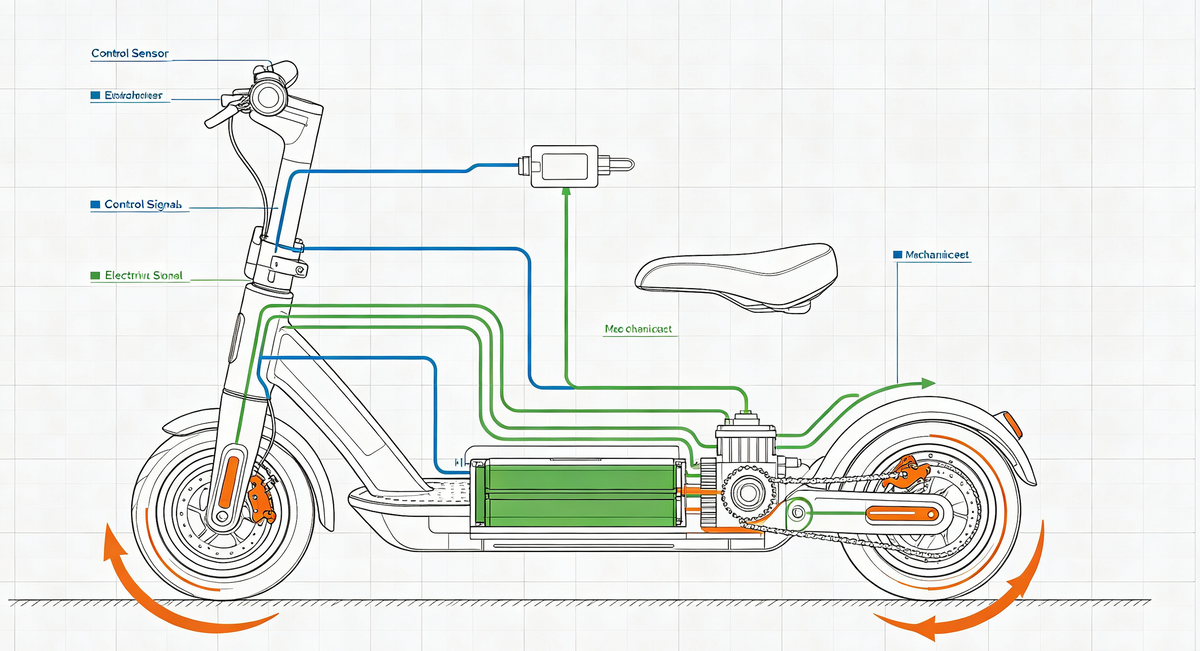
Electric scooter acceleration can feel almost instantaneous. You twist the throttle, the motor responds, and the scooter begins moving forward. To the rider, the entire process may seem simple. However, behind that quick response is a coordinated interaction between electronic signals, electrical power, mechanical force, and road traction.
The throttle does not directly "tell the wheel to turn." Instead, it starts a chain of events involving several key components.
Throttle → Controller → Battery → Motor → Wheel → Road
Understanding this process gives riders a better idea of why different scooters accelerate differently, why hills require more power, and how components such as the controller and battery influence performance.
1. The Rider Creates the First Input
Every acceleration event starts with the rider.
When you twist the throttle, you are effectively requesting a certain level of motor output. The amount of throttle movement provides the scooter's electronic system with information about how much acceleration the rider wants.
A small throttle movement generally represents a relatively gentle request, while a larger movement can request stronger acceleration.
This is important because an electric scooter does not normally operate like a basic switch.
Instead of simply having two states — on and off — the throttle allows the control system to respond progressively.

The physical movement of your hand is therefore converted into information that the scooter's electronics can understand.
2. The Throttle Creates an Electronic Signal
Inside the throttle is a sensor designed to detect its position.
As the throttle moves, the sensor produces a changing electrical signal. That signal travels through the scooter's wiring toward the controller.
This is the first major transformation in the process:
Hand movement → Electronic signal
The signal itself is not the large amount of energy needed to propel the scooter.
Instead, it acts more like an instruction.
Think of it as telling the scooter:
"I want more power."
The controller then decides how the drive system should respond to that request.
This distinction is important when understanding electric scooters. The throttle is primarily an input device, while the controller manages the much larger flow of electrical energy used by the motor.
3. The Controller Interprets the Request
The controller is one of the most important components in the acceleration system.
It receives the throttle signal and processes it before controlling the motor.
The controller's job is not simply to send electricity to the motor. It manages the electrical power delivered to the motor according to the system's operating conditions.
This allows the scooter to accelerate in a controlled manner.

The controller can be thought of as the communication and power-management center between the rider's command and the motor.
Without this stage, the scooter would not have the same level of controlled acceleration found in modern electric drive systems.
4. The Battery Provides the Energy
The controller can manage electrical power, but the energy has to come from somewhere.
That source is the battery.
An electric scooter battery stores electrical energy until the scooter needs it. When the rider requests acceleration, the battery supplies energy to the drive system.
Several battery specifications can influence the scooter's electrical characteristics.
Voltage describes the electrical potential of the battery system, while capacity indicates how much energy can be stored.
However, battery capacity should not be viewed as a direct measurement of acceleration.
A scooter's acceleration depends on how the battery, controller, motor, and drivetrain work together.
For example, a large-capacity battery may provide excellent riding range, but that does not automatically mean the scooter will accelerate faster than another scooter.
5. Electrical Power Reaches the Motor
Once the controller processes the throttle request and manages the available electrical energy, power is delivered to the motor.
This is where the process begins to change from electronic control into mechanical movement.
The motor uses electrical energy to create electromagnetic forces.
Those forces produce rotational movement inside the motor.
Electrical energy → Electromagnetic force → Rotation
This conversion happens extremely quickly.
For many electric scooters, the motor is integrated into the wheel itself as a hub motor. In other designs, the motor can transmit power through a separate mechanical drivetrain.
Regardless of the exact configuration, the objective is the same:
Convert electrical energy into useful mechanical motion.
6. Motor Torque Creates the Force for Acceleration
One of the most important factors during acceleration is torque.
Torque is rotational force.
When the scooter is standing still, the motor needs to generate enough torque to begin rotating the wheel and overcome resistance.
Once the scooter is already moving, the requirements change.
The motor must continue producing enough force to increase speed or maintain movement against factors such as rolling resistance, aerodynamic drag, rider weight, and road conditions.

This is why acceleration is not determined by motor wattage alone.
Motor design, controller behavior, battery capability, scooter weight, tire characteristics, and riding conditions can all affect how acceleration feels.
7. The Wheel Turns
After the motor produces rotational force, that force causes the drive wheel to rotate.
For a hub-motor scooter, the motor and wheel are closely integrated. The motor's rotational movement directly contributes to wheel rotation.
At this stage, the energy conversion can be summarized as:
Battery energy → Motor rotation → Wheel rotation
The wheel itself does not simply move forward through the air.
It rotates against the road surface.
This creates the next and final part of the acceleration process: traction.
8. The Tire Connects the Scooter to the Road
The tire is the physical connection between the scooter and the ground.
As the drive wheel rotates, the tire interacts with the road surface and generates the traction needed to move the scooter forward.
This means that motor power alone is not enough.
If the available force exceeds the tire's ability to maintain traction, the wheel can lose grip.
Road conditions therefore matter.
Wet pavement, loose gravel, sand, uneven surfaces, and other conditions can reduce available traction.
Tire design and condition also influence how effectively motor force is transferred to the ground.

This is the final step that transforms motor rotation into actual scooter movement.
9. Why Some Scooters Accelerate Faster
If the basic acceleration process is similar, why do different electric scooters feel so different?
The answer is that acceleration is the result of the entire system rather than one individual component.
Several factors can influence the result.
Motor Capability
A motor capable of producing greater torque can provide stronger acceleration under suitable conditions.
Controller Characteristics
The controller determines how electrical power is managed and delivered to the motor.
Battery Capability
The battery must be able to supply the electrical energy required by the drive system.
Scooter Weight
A heavier scooter and rider combination requires more force to accelerate.
Tire and Road Conditions
Available traction determines how effectively motor force can be converted into forward movement.
Riding Conditions
Uphill terrain, wind, rider weight, and acceleration style can all change the power requirements.
Therefore, looking at only one specification rarely tells the complete story.
10. What Happens During Uphill Acceleration?
Acceleration becomes more demanding when riding uphill.
Instead of only overcoming rolling resistance and air resistance, the motor must also work against gravity.
The steeper the slope, the more force is required to maintain movement.
When the rider twists the throttle on an incline, the controller may need to manage greater electrical demand from the battery so that the motor can produce sufficient torque.
This is why a scooter that accelerates strongly on flat pavement may behave differently on a steep hill.
The available motor torque, electrical system, total load, and slope all become important.
11. Why Acceleration Uses More Battery Energy
Acceleration requires energy.
Whenever the scooter increases its speed, the motor must provide additional mechanical energy to increase the motion of the combined scooter-and-rider mass.
Repeated hard acceleration can therefore consume more battery energy than riding at a steady moderate speed.
The same principle applies when climbing hills.
The scooter must continually provide additional energy to overcome gravity.
This is one reason real-world range can vary significantly from a manufacturer's maximum range figure.
Range depends on actual riding conditions rather than one fixed number.
12. What Happens After You Stop Accelerating?
When you release the throttle, the system no longer receives the same acceleration request.
The controller responds according to the scooter's control system.
The motor may stop receiving drive power, while the scooter continues moving due to its existing momentum.
The scooter will gradually slow because of rolling resistance and aerodynamic drag. Braking systems can provide additional deceleration when required.
Some scooters also use electronic or regenerative braking functions.
The exact behavior depends on the design of the scooter and its control system.
13. The Complete Acceleration Chain
The entire process can now be summarized in seven simple stages:
1. Rider
The rider twists the throttle.
2. Throttle
A sensor detects the throttle position.
3. Controller
The controller interprets the signal and manages the requested motor response.
4. Battery
The battery provides electrical energy.
5. Motor
The motor converts electrical energy into rotational force.
6. Wheel
The wheel rotates and transfers the motor's force through the tire.
7. Road
The tire generates traction and pushes the scooter forward.

What feels like one simple movement is actually a coordinated chain involving electronics, electrical energy, electromagnetic force, mechanical rotation, and tire traction.
Why This Matters When Choosing an Electric Scooter
Understanding acceleration can also help when comparing electric scooters.
Instead of focusing only on a single motor rating, riders can consider the complete system.
A suitable scooter should have a motor appropriate for the intended use, a battery system that supports the desired riding conditions, and a controller capable of managing the available power.
The scooter's weight, tire design, suspension, riding environment, and rider requirements should also be considered.
For everyday urban riding, smooth and predictable acceleration may be more useful than simply having the highest possible power output.
For steep terrain or demanding riding conditions, torque and overall system capability become more important.
Every time you twist the throttle, an entire chain of events begins inside your electric scooter.
Your hand creates an input. The throttle converts that movement into an electronic signal. The controller interprets the request and manages electrical power from the battery.
That energy reaches the motor, where electrical energy is converted into rotational force. The wheel then transfers that force through the tire to the road.
The result is acceleration.
Throttle → Signal → Controller → Battery → Motor → Wheel → Road
Once you understand this chain, electric scooter acceleration becomes much easier to understand — and the specifications listed on different scooter models become more meaningful.
What feels like a simple twist of the throttle is actually the beginning of a carefully coordinated process that turns electrical energy into movement.
Share:
KuKirin S1 Max Electric Scooter Review|350W Motor, 39KM Range & 25KM/H Top Speed
From Twist to Motion: The Complete Electronic System Inside a KuKirin Scooter